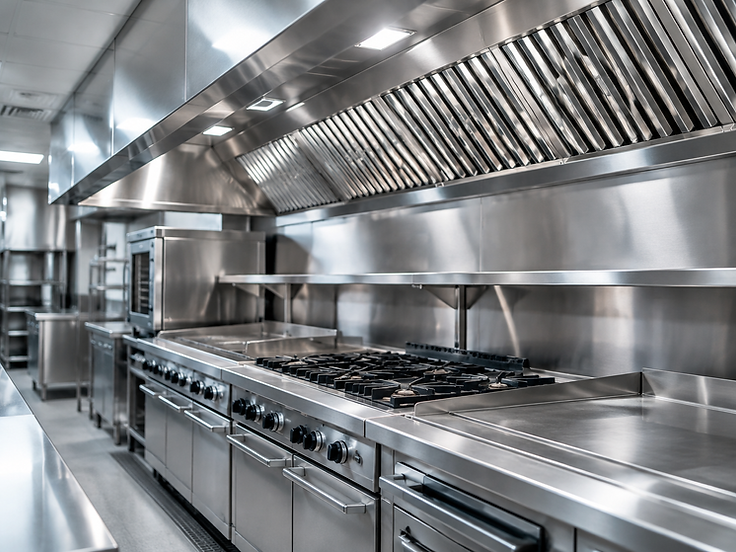
The four parts of a working kitchen extract
Extraction fails when only one part is replaced. A larger fan on undersized ducting will howl, an oversized canopy on a weak fan will not capture, and a sealed kitchen with no replacement air will not extract at all.
- Canopy or hood sized and positioned over the actual cooking equipment
- Grease ducting sized for the extract volume, with appropriate cleaning access
- Extraction fan selected for the duct resistance and roof or wall discharge point
- Make-up air supply so the kitchen is not put under negative pressure
Capture, not just suction
Canopy performance depends on overlap, mounting height and the type of cooking beneath it. A wok line, a plancha and a combi oven produce different plumes, and a single canopy height rarely suits all three. We look at the equipment layout before setting canopy dimensions and extract volumes.
Where the kitchen is in a tenanted building, the discharge point and duct route often drive the design more than anything else — and those need to be agreed with the landlord before fabrication.
Replacement air and comfort
A kitchen extract of any size pulls air out of the room, and that air has to come from somewhere. Without a planned supply, it arrives through the dining room, the toilets and every door gap, dragging odours and draughts with it. We size and route make-up air so the kitchen extracts properly and the rest of the building stays comfortable.
Service and cleaning access
Grease accumulates wherever it can. Access doors, removable panels and drain points are positioned so the duct can be cleaned properly, because a grease duct that cannot be reached becomes a fire risk and a smell problem.
Included in our scope
- Kitchen survey and canopy sizing
- Extract volume and fan duty calculation
- Galvanised or stainless grease ducting
- Canopy, fan and discharge installation
- Make-up air supply design
- Commissioning with airflow verification